The QESCO online bill calculator helps you easily find out how much your electricity bill might be. Just enter the number of units used and choose your tariff category to get an estimate.
The calculator uses fixed rates and unit charges for each category. But remember, the total amount does not include extra charges like Fuel Price Adjustment (FPA) and Quarterly (QTR) taxes, which can increase your final bill.
This tool also explains the difference between protected and unprotected categories, so you can better understand your bill.
QESCO Electricity Bill Calculator
| Fixed Charges (PKR) | Rate per Unit (PKR) | Total Bill (PKR) |
|---|---|---|
| 0 | 0 | 0 |
Total bill is calculated based on QESCO tariff rates. This amount does not include Fuel Price Adjustment (FPA) or QTR tax, therefore the original bill amount may be different.
How QESCO Bill Calculator Works?
The QESCO Bill Calculator helps you quickly check your monthly electricity bill. It works by using the number of units you’ve used and your tariff category. The process is easy and fast.
Just follow these simple steps:
Enter Units Used: Type the number of units you used this month.
Select Tariff Category: Choose your category like Residential, Commercial, Industrial, Agriculture, Temporary Supply, or Time of Use (TOU).
View Bill Details: The calculator will show you the unit rate, any fixed charges, and the total bill amount.
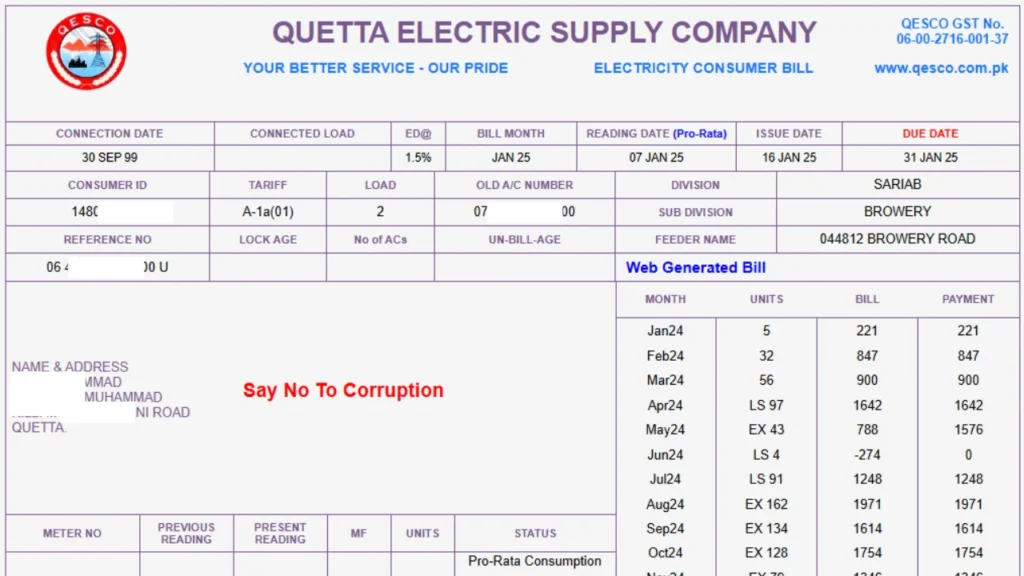
The calculator uses specific rates and fixed charges based on your selected category.
QESCO Tariff Categories
QESCO has different tariff categories to match the needs of various types of consumers. These categories decide the rate per unit of electricity and any fixed charges based on how much electricity you use. The main categories include residential, commercial, industrial, agriculture, temporary supply, and Time of Use (TOU).
Each category has its own rules, charges, and rates, depending on the type of connection and usage. Knowing your tariff category helps you understand how your bill is calculated and why your charges may be different from others.
Residential Tariff (For Home Use)
The residential tariff is for regular households that use electricity for daily needs like lighting, fans, appliances, etc. The unit rate increases as your usage goes up—so the more electricity you use, the higher the rate per unit.
For example, if you use 100 units or less, the rate is Rs. 16.48 per unit. For 101 to 200 units, the rate is Rs. 22.95 per unit, and for 201 to 300 units, it becomes Rs. 34.26 per unit. When your usage goes above 300 units, fixed charges are also added. For 301 to 400 units, the rate is Rs. 39.15 per unit with a fixed charge of Rs. 200. If you use 401 to 500 units, the rate is Rs. 41.36 per unit with a fixed charge of Rs. 400. The rate continues to increase for higher usage:
- 501–600 units at Rs. 42.78 + Rs. 600 fixed charge
- 601–700 units at Rs. 43.92 + Rs. 800 fixed charge
- 701+ units at Rs. 48.84 with a fixed charge of Rs. 1000
Commercial Tariff (For Business Use)
The commercial tariff is made for businesses like shops, offices, and other commercial places. Since businesses usually use more electricity than homes, their rates are higher than residential rates.
Under the commercial tariff, if a business uses up to 5 units, the rate is Rs. 38.59 per unit with a fixed charge of Rs. 1000. If the usage is more than 5 units, the rate increases to Rs. 40.91 per unit with a fixed charge of Rs. 1250. These rates are designed to match the higher power needs of commercial consumers.
Industrial Tariff (For Factories)
The industrial tariff is for large factories and industries that need a lot of electricity for production and operations. Although these users consume more power, their rates are lower than commercial users, to support industrial growth.
If an industry uses up to 25 units, the rate is Rs. 31.95 per unit with a fixed charge of Rs. 1000. If the usage is more than 25 units, the rate becomes Rs. 31.88 per unit with a fixed charge of Rs. 1250. These rates are made to help industries manage their electricity costs while meeting high energy demands.
Agriculture Tariff (For Farming)
The agriculture tariff is made for farmers who use electricity for irrigation and other farming needs. This tariff is usually cheaper to help support agriculture in Pakistan.
If a farmer uses up to 5 units, the rate is Rs. 41.02 per unit. If the usage is more than 5 units, the rate drops to Rs. 30.06 per unit, but a fixed charge of Rs. 400 is added. This setup helps farmers manage their electricity costs while keeping their farms running.
Temporary Supply Tariff
The temporary supply tariff is for people who need electricity for a short period, like for a function, event, or construction work. Since this is not a regular connection, the rate is higher. The cost is Rs. 59.09 per unit, and there is a fixed charge of Rs. 2000.
Time of Use (TOU) Tariff
The Time of Use (TOU) tariff is a special billing system where the electricity rate changes based on the time of day. The goal is to encourage people to use electricity during off-peak hours, when demand is low.
In this system, your usage is divided into peak hours (usually during the day) and off-peak hours (usually at night). The peak rate is Rs. 48.00 per unit, and the off-peak rate is Rs. 41.68 per unit. This helps reduce pressure on the system during busy hours and spreads out electricity use throughout the day.
Protected vs Unprotected Charges
When you check your electricity bill, you might see the words protected and unprotected charges. It’s good to know what they mean because they can change the total bill amount. Knowing the difference will help you understand why your bill is high or low.
Protected Charges
Protected charges are fixed amounts set by the government. These charges stay the same and don’t change with market prices. For example, if you are in the residential category, your fixed charges will depend on how many units you use — and they will stay the same every month.
Usually, protected charges are easy to understand because they are stable and don’t change often. They will only increase if QESCO or the government decides to change the rates.
Unprotected Charges
Unprotected charges are extra costs that can change every month. They depend on things like fuel prices and government taxes. These charges are added at the end of your bill.
Some common unprotected charges are:
- Fuel Price Adjustment (FPA): This is based on the cost of fuel used to make electricity. If fuel prices go up or down, this charge also changes.
- Taxes (like QTR): These are government taxes that can be different each month.
Because unprotected charges can change, your total bill may be higher or lower each month depending on these factors.